Tuesday, March 12, 2013

The Trouble With (A) Pot

This is a Rust Driver.


My Rust Driver, as a matter of fact.  My pal, Josh, got this for me many, many moons ago.  It’s a pretty badass plexi-esque dirt pedal, the kind of thing you can get a lot of zing out of.  Solo time?  Step on it.  Need some big ol’ rhythmic crunch?  Step on it.  It’s a fun pedal.

After using it for about three years, the potentiometer became unreliable, to say the least.  It was crackling, making noise when I turned it and seemed as if it was cutting out.  Eventually, the potentiometer started spinning freely and the pedal stopped working.

I opened it up and found that the chintzy potentiometer had come apart.   
It hasn't come apart here; this is after I tried to reassemble it.  Bear with me...
Here’s what it looks like out of the box:

Lame.  What the hell is that thing, even?  Seriously!  Did that come out of an Atari controller or something?  Who uses something this cheap in a piece of musical equipment?  WHO?!?

The Rust Driver is made by HAO.  HAO is distributed by Godlyke Distributing Inc.  I guess that’s who.

My first idea was to try to reassemble the pot, which did not work.  At all.  I tried to find one of these jive turkey pots but had no luck.  The Rust Driver ended up sitting in a drawer and I ended up not worrying too much about it for quite some time.

Eons passed…

Of course, at some point, I found a need to test drive some dirt pedals, so out came ye olde Rust Driver.  I popped it open and, in addition to the garbage pot, saw some other things that chapped my hide in a big, bad way.  This stand off, for example:
Really?  This thing broke loose from the glue the first time I opened the pedal, trying to figure out what was going wrong.  Granted, the Rust Driver is an INCREDIBLY low profile pedal.  Small enclosure, tiny footprint.  Still, this just doesn’t seem necessary.

Another thing is this wretched, rubbery glue crap:

Seriously?  Is this in any way necessary?  If so, someone please, please, please enlighten me, because it just seems like a massive mess o’ *ssholery.  What if one of these components kicks the bucket?  Do I laboriously scrape away at this gunk?  Do I send it to HAO for repair?

Good luck on that count.  No dice, as far as I can tell, on any kind of service.

Left to my own devices, I started thinking about it and realized a 16mm Alpha pot would fit in the space taken up by the disposable pot in the Rust Driver.   
I tried to test the pot to identify its value but got nothing.  This was truly a dead pot.  I searched the interwebs for the codes printed on the pot and came up with a value of 500k and happened to have an A500k Alpha pot on hand.  Clipped out the Kleenex pot, installed the Alpha and… it worked.  Done deal.


Monday, March 11, 2013

John LaChapelle


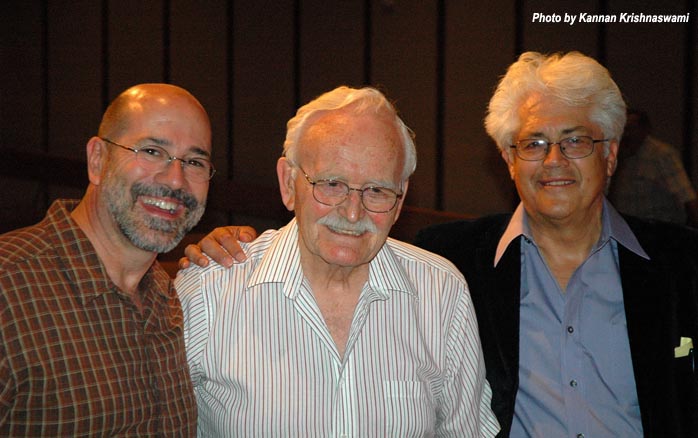
March 5th, 2013, we lost a great guitarist, guitar instructor and human being.  John J. La Chapelle was 91 and most of his years on this earth were spent bringing the joy of music to thousands of students and audience members and fellow musicians.

Left to right: Jeff Day, John La Chapelle, Larry Coryell
I took lessons from John twenty seven years ago, starting around 1986.  He would whack his tuning fork on his knee, tune up his beautiful archtop electric and away we’d go. In the time I studied with him, I went from absolute beginner to learning songs off records by ear and playing in the high school jazz band.  John turned me on to Les Paul by loaning me a rare, valuable, original 10” EP from The Les Paul Trio, which included the amazing “Guitar Boogie” and was a revelation to me.  I came back the next week having learned to play “Guitar Boogie” and John was quick to praise my accomplishment, as he always was.  Endlessly encouraging and inspiring, John was a truly exceptional, gifted instructor.

I was fortunate enough to perform with John once, for a jazz band performance.  He was invited to sit in and play a solo.  I asked if he needed me to move my music stand so he could see the sheet music and he said, “No, that’s okay.”  I was sweating bullets. John was, by then, as much a guitar hero to me as Hendrix or Page and I was nervous to play back to back solos with this guy.  And I should have been!  I played some kind of sloppy mess then he took everyone into the heavens with a beautiful, expressive, perfectly harmonious solo.  Regardless of my performance, it was a day I’ll never forget and the memory is a warm one.


John with Lee Berger
We have so many teachers throughout our life; John La Chapelle was one of the best I knew and I was so, so lucky to have him show me a chord or two.  Rest in piece, brother.

Monday, February 18, 2013

Saving Jekyll & Hyde


Quite some time ago, a friend of mine gave me a broken Visual Sound Jekyll & Hyde overdrive/distortion pedal.  At the time, I thought I’d gut it and put two other effects in there.  Never got around to it, though.  Which, in the long run, has turned out to be a good thing.

Since getting a Ceriatone JTM 45, I’ve come to rely on dirt pedals for overdrive rather than fuzz.  Lately, I’ve been trying as many overdrive pedals as I can get my hands on.  I started thinking about building an Ibanez Tube Screamer clone and messing with the circuit, which got me thinking about IC chips, which reminded me about that busted Jekyll & Hyde pedal gathering dust in a drawer.  I opened it up, looked at all the many, many IC chips, figured I’d get some sockets…

Then I thought, “What would it take to fix this thing?”  I mean, the Jekyll & Hyde is a somewhat famed pedal these days.  It’s a cool TS808 Tube Screamer type overdrive with a handy bass boost switch as well as a tough distortion.  The two effects can be used separately or together.  It has a pretty significant footprint on a pedal board but that’s a lot of versatility in one stomp box.
That's a big stomp box!
I opened the thing up and immediately noticed evidence of repairs.  There was a wire connecting one of the switch lugs to a trace, jumpers from pot lugs to traces, etc.


The reason these repairs were necessary comes to down to the design.  The pots and foot switches are PCB (Printed Circuit Board) mounted, which creates a potential for stress to the solder joint (and PCB) when the pots are turned or the switches are stomped.  The result, over time, is a broken solder joint, which means a broken pedal.  This isn't what could happen, it's what will happen.
Notice the potentiometer on the far right broken completely loose from solder pads.
A lot of pedal manufacturers use board mount components in their pedals.  The practice has its benefits, mainly in that it’s generally cheaper and you can fit the whole mess into a smaller enclosure.

In my humble opinion, however, it’s a questionable practice at best.  I just don’t like it.  With pots, jacks, switches, etc. mounted to the enclosure rather than the board, there’s significantly less chance of a solder joint breaking.  And if your pedal stops working, it makes it a lot easier to figure out and fix the problem.

Having said that, Visual Sound does take the time to drill holes for the anchors on the pots, which is going to more or less eliminate the chance of the pot rotating very much if the nut comes loose.  That’s an effective, simple solution for board mounted pots.  But there’s plenty of room in this enclosure for the foot switches to have been wired in rather than board mounted.  The rocker switches controlling the bass boost on the overdrive and the sharp/blunt control on the distortion aren’t attached to the board, so why the foot switches?

I started looking at what it would take to fix the broken traces on the pot and foot switch, both of which were completely broken loose from the solder pads.  It occurred to me that all of the solder joints on the pots and foot switches were ultimately in danger of cracking.  So, what if I jumpered/wired all of those lugs directly to the components/traces?

It seemed like a lot of work so I decided to think about it for a while.  Where lugs connected to traces, I could scrape the board and solder a jumper.  Where lugs connected to resistors and capacitors, I figured I could run a wire directly from the appropriate leg of the component to the lug.  In spite of the labor and the potential for it to get messy, I knew it could work.  I decided to go for it.

Hey, whaddayaknow?  It worked!  Best of all, it worked right away.  A little prep and planning went a long way with this project.
As you can see, the wires are pretty freakin' ridiculous.  I could have made them quite a bit shorter and kept the job neater, but there’s plenty of room for the wires with the bottom on.  I also tightened downed the pots and foot switches really well before soldering the board to them in an effort to eliminate as much stress to the solder joints as possible.

I’m happy I decided to fix this thing because I like the way it sounds.  The bass boost on the overdrive is a killer option.  It’s definitely something I would consider building into a TS808 clone.  The distortion is pretty rich and you have a lot of control over the EQ and amount of gain.  Like I said, that’s a ton of options in one stomp box.  It makes a great pedal for practicing at home.  It’s not what I’m looking for to use live but I like having it in my arsenal.

Hallelujah, let's rock!

The title of this blog comes from the song “Green Trumpet” by Seattle, Washington’s infamous U-Men.  Vocalist John Bigley utters the phrase before guitarist Tom Price begins his creepy, descending guitar lick, leading drummer Charlie Ryan and bassist Jim Tillman into the outer rings of hell.  The U-Men.  One of the greatest bands, ever.  I’ll talk more about The U-Men another time, you can count on it.
Guess who?
Music is universal, all encompassing, existing in all cultures and societies.  You’ve heard it all before but it’s no less true.  It unites us, comforts us, lifts us up, gives us strength, enriches our lives and makes us want to shake our butts.  Songs act as place markers in our history and the soundtrack to our lives.  As Frank Zappa said:

“Information is not knowledge.
Knowledge is not wisdom.
Wisdom is not truth.
Truth is not beauty.
Beauty is not love.
Love is not music.
Music is THE BEST.”
Music is THE BEST.
Music really is THE BEST.  And the phrase, “Hallelujah, let’s rock” resonates with me because, like Ozzy says, rock ‘n’ roll is my religion and my law.  I love music and rock music in particular, and this blog is no more than a chance for me to write about something I love.  It’s that simple.

Where am I going with this thing?  Everywhere.  Anywhere I want.  Bands, songs, guitarists, drummers, bassists, guitars, stomp boxes, amps, producers, engineers, studios… in short, anything about music.

So… hallelujah, let’s rock!